When I was about seven or eight years old, I remember my mom taking me to the bank to open a savings account. She explained that if I put some of my allowance in savings, that money would grow over time.
Well, that doesn’t work anymore.
In fact, if you put your money in a savings account, you’ll end up with less than you started with – at least in terms of real purchasing power.
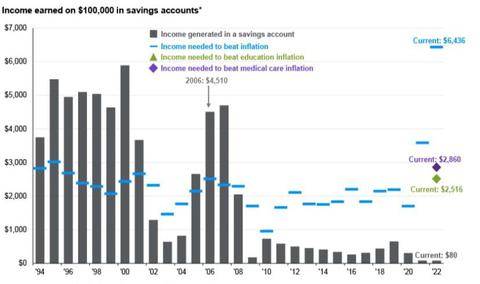
The last time a cash savings account yielded enough interest income to beat inflation was in 2007.
This provides yet another example of how Federal Reserve monetary policy creates misallocations and distortions in the economy.
Looking closely at the chart, you’ll notice that savings yields fall below the inflation level when the Fed engages in loose monetary policy.
The first dip below the inflation level is in 2002 — in the wake of the bursting dot-com bubble. In 2001, the Fed began pushing interest rates down. It started at 6% in January 2001 and by January 2002, rates were pegged at 1.25%.
We see the next plunge in savings yields in 2008, as the Fed dropped rates to zero and launched quantitative easing in response to the Great Recession.
Since then, savings have never recovered. Cash accounts failed to generate enough income to beat inflation even during the “low inflation” years after the financial crisis.
