April 7th, 2020 § Comments Off on Experts Simulated a Coronavirus Pandemic Last Year and It Killed 65 Million § permalink
By Adam K. Raymond, Intelligencer
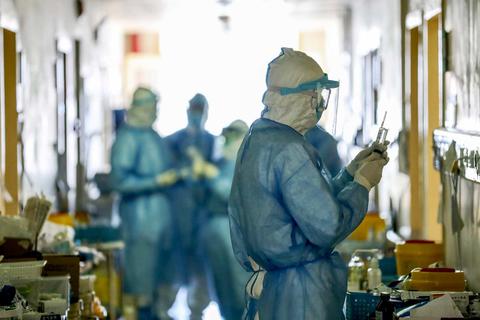
Last October, two months before the coronavirus that causes COVID-19 emerged in central China, a group of public-health experts gathered in New York City for a simulation. Their objective was to determine how industry, national governments, and international institutions could work together to respond to a hypothetical “pandemic with potentially catastrophic consequences.”
Such a pandemic is no longer just a hypothetical. This week, the Centers for Disease Control and Prevention said it’s preparing for a coronavirus pandemic and the organization’s former director flatly declared that COVID-19 “will become a pandemic.”
The characteristics of the virus currently causing global havoc are remarkably similar to the one proposed in the simulation, dubbed “Event 201.” The simulated virus, called CAPS for Coronavirus Associated Pulmonary Syndrome, began in Brazilian pigs who passed it to farmers. It resulted in symptoms ranging from mild flu-like symptoms to pneumonia. Three months in, the hypothetical illness had caused 30,000 illnesses and 2,000 deaths.
The fake news report that played at the beginning of the simulation looks like a nightly news report from today. » Read the rest of this entry «
April 6th, 2020 § Comments Off on Why This Crisis Is A Turning Point In History § permalink
by John Gray, NewStatesman.com
The era of peak globalisation is over. For those of us not on the front line, clearing the mind and thinking how to live in an altered world is the task at hand…
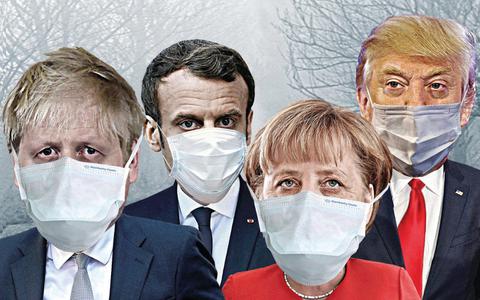
The deserted streets will fill again, and we will leave our screen-lit burrows blinking with relief. But the world will be different from how we imagined it in what we thought were normal times. This is not a temporary rupture in an otherwise stable equilibrium: the crisis through which we are living is a turning point in history.
The era of peak globalisation is over. An economic system that relied on worldwide production and long supply chains is morphing into one that will be less interconnected. A way of life driven by unceasing mobility is shuddering to a stop. Our lives are going to be more physically constrained and more virtual than they were. A more fragmented world is coming into being that in some ways may be more resilient.
The once formidable British state is being rapidly reinvented, and on a scale not seen before. Acting with emergency powers authorised by parliament, the government has tossed economic orthodoxy to the winds. Savaged by years of imbecilic austerity, the NHS – like the armed forces, police, prisons, fire service, care workers and cleaners – has its back to the wall. But with the noble dedication of its workers, the virus will be held at bay. Our political system will survive intact. Not many countries will be so fortunate. Governments everywhere are struggling through the narrow passage between suppressing the virus and crashing the economy. Many will stumble and fall.
In the view of the future to which progressive thinkers cling, the future is an embellished version of the recent past. No doubt this helps them preserve some semblance of sanity. It also undermines what is now our most vital attribute: the ability to adapt and fashion different ways of life. The task ahead is to build economies and societies that are more durable, and more humanly habitable, than those that were exposed to the anarchy of the global market. » Read the rest of this entry «
April 5th, 2020 § Comments Off on ‘Modern Piracy’: Germany Joins France & Canada In Accusing Trump Of Stealing Masks § permalink
From ZeroHedge.com
On Friday Germany lashed at the United States for what one top lawmaker in Berlin called “an act of modern piracy” after US authorities “confiscated” a Chinese-manufactured shipment of 200,000 protective masks after they arrived at a port in Thailand while en route to Germany.
In an amazing irony, the masks had actually been purchased by the German government from an American company — though manufactured in China — and yet the US still intercepted them at a moment Trump has warned US companies with factories in China they’ll “have a big price to pay” if they don’t increase supply to the US.
By the end of the week in total three US allies accused Washington of theft over intercepts and seizures of supplies being shipped out of China, namely Canada, France and Germany.
Berlin Interior Minister Andreas Geisel stated bluntly of Washington’s brazen move: “Even in times of global crisis, we should not be ruled by Wild West methods,” according to Deutsche Welle. The German newspaper explained further:
The state of Berlin had ordered FFP2-class respirators for Berlin police officers, who continue to operate during the crisis.
The chairman of the SPD parliamentary group, Rolf Mützenich, said the confiscation was “illegal” and called for the incident to be clarified.
Interestingly, this whole episode underscores just how desperately strained the US health system is becoming under the COVID-19 panemic, considering the unprecedented lengths the US administration is willing to go, essentially resorting to “piracy” – as Germany put it. » Read the rest of this entry «
April 4th, 2020 § Comments Off on The Afghan Air Force Gets More Money Than Infectious Disease Prevention § permalink
by Daniel R. DePetris, for The American Conservative
The coronavirus has exposed an awful crisis of priorities: we fund overseas wars before domestic health.
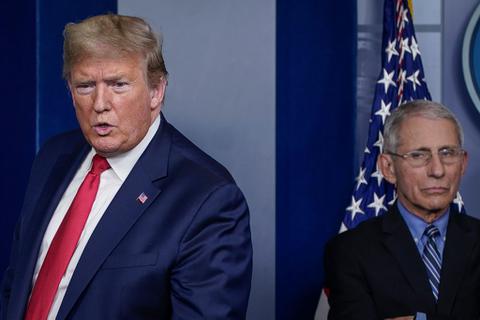
U.S. President Donald Trump and Dr. Anthony Fauci, director of the National Institute of Allergy and Infectious Diseases, depart a briefing on the coronavirus pandemic, in the press briefing room of the White House on March 24, 2020 in Washington, DC.
There are certain moments in history that are so disastrous that they force a nation to think long and hard about its priorities. What truly matters to the health, welfare, security, and prosperity of the United States? Is taxpayer money being spent wisely? Is it being allocated to the right things? How could we have been so unprepared for a threat that was staring us all in the face?
The coronavirus storming the United States is just such a moment.
The virus is nothing short of a global health epidemic. As of this writing, it has claimed the lives of nearly 38,000 people in over 160 countries and sickened hundreds of thousands. Approximately 165,000 cases in the United States have been reported, with over 3,100 Americans having succumbed to the disease. Forty-one percent of those cases are in New York State, where the virus taken a horrifying toll. Between March 30 and 31, an additional 332 New Yorkers died from complications.
The deaths are, of course, tragic. But just as disturbing is the state of America’s health care system. It is completely overwhelmed and may have already reached a breaking point. » Read the rest of this entry «
April 4th, 2020 § Comments Off on The Bigger Picture Is Hiding Behind A Virus § permalink
Jonathan Cook’s Blog
Things often look the way they do because someone claiming authority tells us they look that way. If that sounds too cynical, pause for a moment and reflect on what seemed most important to you just a year ago, or even a few weeks ago.
Then, you may have been thinking that Russian interference in western politics was a vitally important issue, and something that we needed to invest much of our emotional and political energy in countering. Or maybe a few weeks ago you felt that everything would be fine if we could just get Donald Trump out of the White House. Or maybe you imagined that Brexit was the panacea to Britain’s problems – or, conversely, that it would bring about the UK’s downfall.
Still feel that way?
After all, much as we might want to (and doubtless some will try), we can’t really blame Vladimir Putin, or Russian troll farms spending a few thousand dollars on Facebook advertising, for the coronavirus pandemic. Much as we might want to, we can’t really blame Trump for the catastrophic condition of the privatised American health care system, totally ill-equipped and unprepared for a nationwide health emergency. And as tempting as it is for some of us, we can’t really blame Europe’s soft borders and immigrants for the rising death toll in the UK. It was the global economy and cheap travel that brought the virus into Britain, and it was the Brexit-loving prime minister Boris Johnson who dithered as the epidemic took hold.
The bigger picture
Is it possible that only a few weeks ago our priorities were just a little divorced from a bigger reality? That what appeared to be the big picture was not actually big enough? That maybe we should have been thinking about even more important, pressing matters – systemic ones like the threat of a pandemic of the very kind we are currently enduring. » Read the rest of this entry «
April 3rd, 2020 § Comments Off on Internal Documents: Monsanto Knew For YEARS Their Products Damaged Farms § permalink
by Mac Slavo, SHTFplan.com
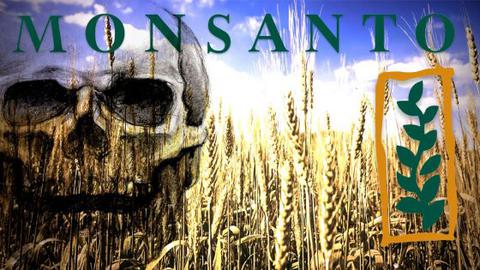
According to internal documents, Monsanto and Germany’s BASF knew their products would destroy farms in the United States. The firms disregarded the risks even while they planned on how to profit off farmers who would buy Monsanto’s new seeds just to avoid the damages caused by their products.
The documents (some of them date back more than a decade) have been uncovered during a recent successful $265 million lawsuit brought against both firms by a Missouri farmer. The internal documents were seen and released by the Guardian. They also revealed how Monsanto opposed some third-party product testing, in order to curtail the generation of data that might have worried regulators. In some of the internal BASF emails, employees were even joking about sharing “voodoo science“ and hoping to stay “out of jail.”
“The documents are the worst that I’ve ever seen for any case that I’ve worked on,” said lawyer Angie Splittgerber, a former tobacco industry defense attorney who works with farmers who are suing Monsanto and BASF. “So many of them put things in writing that were just horrifying.”
Unfortunately, this isn’t the first time Monsanto has been caught trying to hide the damages that are done with their products.
Records showed that at private meetings dating back to 2009, agricultural experts warned that the plan to develop a dicamba-tolerant system could have catastrophic consequences. Dicamba herbicide would normally kill crops such as soybean or cotton, but Monsanto altered the genes in these crops to create genetically modified varieties that are resistant to the herbicide. This meant that farmers can spray the weedkiller directly on those soybean or cotton plants to destroy weeds but leave the crops unharmed. » Read the rest of this entry «
April 3rd, 2020 § Comments Off on A Russian Firewall For Venezuela Against Us Sanctions § permalink
By M. K. Bhadrakumar, IndianPunchline.com
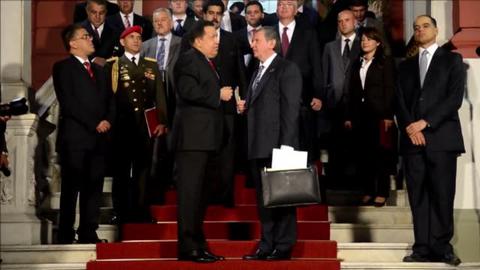
Igor Sechin, President of the Russian oil company Rosneft (R) being greeted by late Venezuelan President Hugo Chavez (L), self-styled leader of the ‘Bolivarian Revolution’ at doorstep of the presidential palace, Caracas, Sept 2012.
The optics of the Russian oil leviathan Rosneft’s decision to sell its subsidiary Rosneft Trading SA and sell all its assets in Venezuela after the US Treasury sanctioned its trading arm two weeks ago as part of Washington’s regime change project to oust president Nicolás Maduro, may not look good to the uninformed outside observer.
It may appear, prima facie, that Russia is ditching Maduro and succumbing to US president Donald Trump’s latest act of weaponisation of sanctions against the Venezuelan government. At least, that was how the BBC Radio’s morning bulletin today projected the development.
But as one digs deeper, it emerges, on the contrary, that the Kremlin is having the last laugh. What Russia is doing is, funnily enough, borrowing from the US diplomatic toolbox — the equivalent of what the US does constantly in its war on terrorism, that is, whenever a terrorist group that Washington sponsors gets exposed on the battlefield, it gets promptly rebranded and reappears as a new avatar, and life moves on.
So, what is happening needs to be understood as follows: Rosneft is disengaging from its trading arm Rosneft Trading SA, the Geneva-based trading subsidiary, in a deliberate ploy to create a firewall against potential US sanctions in future. » Read the rest of this entry «
